The Era of Autonomous AI Agents: Claude vs OpenAI Codex 2026
Just two short years ago, developers rejoiced at the “smart autocomplete” features in IDEs, considering tools like GitHub Copilot to be a technical revolution. But today, as of April 2026, the paradigm of the web development industry has changed forever. Artificial intelligence has ceased to be merely an advisor generating code snippets. It has evolved into an autonomous engineer and executor. We have officially entered the era of Agentic Software Development. In this reality, AI agents take over the entire workflow: from analyzing a ticket in a bug tracker to architectural planning, writing code, generating tests, and submitting the final pull request.
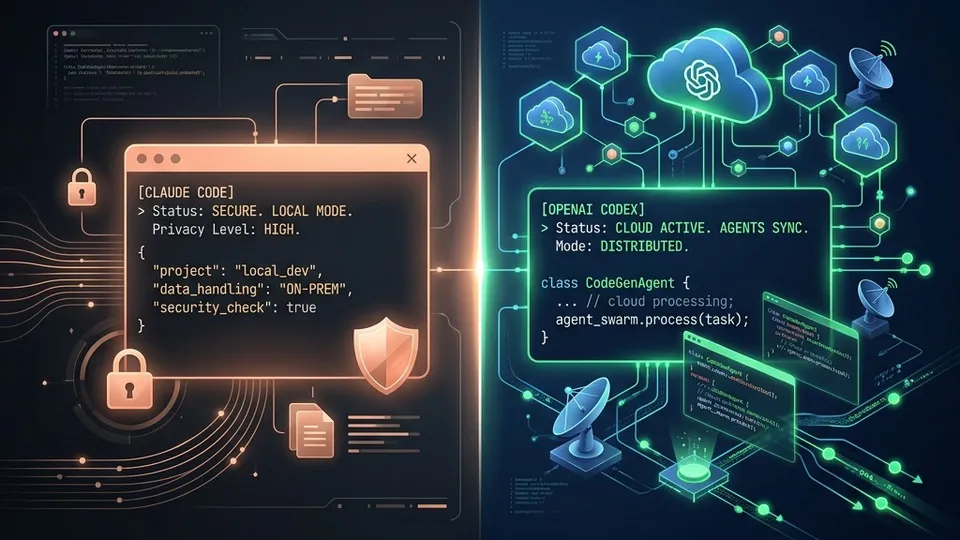
In this highly competitive market, a powerful duopoly has firmly established itself, driven by fundamentally different philosophies. Anthropic wagers on local security, deep repository reasoning, and terminal-first operations, while OpenAI builds a global cloud ecosystem powered by massively parallel sub-agents. In this comprehensive article—backed by official spring 2026 releases and real-world case studies—we will dissect the capabilities of these tools and their profound impact on modern business.
Anthropic’s Architecture: Claude Code and the Local-First Philosophy
In early spring 2026, Anthropic released a massive update to its flagship product, Claude Code (v2.1+), powered by the latest Claude 4.6 Opus and Sonnet models. While many competitors strive to move development into the browser and cloud sandboxes, Anthropic has taken a completely different path.
The philosophy of the product is clear: “The code belongs to the developer.” Claude Code lives directly in your CLI (command-line interface) and interacts with the local file system without secretly uploading proprietary code to third-party servers.
Key Capabilities of Claude Code in April 2026
- Deep Contextual Reasoning: The Claude 4.6 Opus model possesses a phenomenal context window and a capacity for “multi-layered” reasoning. Unlike agents of yesteryear that “forgot” the hidden links between files, Claude constructs an internal dependency graph of the project. You can ask: “Find where the memory leak occurs when rendering long lists,” and the agent will independently analyze dozens of components, locate the root cause, and propose an elegant fix.
- Model Context Protocol (MCP): This is the standard that flipped the game. By April 2026, MCP integration allows Claude Code to seamlessly connect to your local databases (PostgreSQL, MongoDB), internal enterprise tools, AWS Bedrock, and even Slack. The agent can not only write an SQL migration but also execute a dry run by analyzing the actual table structures on your local machine.
- Claude Code Security: Released in late February, this automatic auditing module works continuously. Before you save a file, the agent background checks the code for vulnerabilities (OWASP Top 10, injections, insecure dependencies). If you accidentally try to commit an access token in a
.envfile, Claude will physically block the operation and issue a stark warning in the terminal. - Computer Use (GUI Interaction): An experimental feature now open to Pro users. Claude Code can now “see” your screen and control the mouse/keyboard. Imagine working on responsive styling for an e-commerce store. Claude can autonomously open Google Chrome, launch dev tools at various viewport sizes, test the clickability of the mobile hamburger menu, and directly edit the CSS files. It’s a revolution in UI/UX testing.
A Practical Example with Claude
Imagine your studio is tasked with refactoring a massive legacy React monolith, migrating it to the high-performance Astro architecture utilizing island hydration.
Using Claude Code, the developer simply types into the terminal:
claude /architect: "Migrate the shopping cart module from React to Astro, leaving interactivity only for the checkout payment button."
Claude:
- Scans the
/src/components/cartfolder. - Separates the logic: static product rendering is rewritten into
.astrofiles, while the highly interactive slice is isolated into a lightweight React componentCheckoutButton. - Automatically adds the
client:loaddirective for the necessary islands. - Prompts the user: “I noticed you’re using an outdated global state management method. Would you like me to rewrite it using Nano Stores for better integration with Astro?”
This approach saves days of monotonous labor, allowing the senior engineer to focus purely on reviewing the architecture.
OpenAI Codex: The Era of Parallel Multi-Agency
While Anthropic focuses on thoughtful local execution, OpenAI has set its sights on massively scalable cloud systems. In March 2026, they unveiled an updated autonomous engine based on specialized, mathematically precise GPT-5.3-Codex models, alongside the incredibly fast GPT-5.4-mini.
OpenAI aggressively pushes the concept of cloud sandboxes and Always-On Agents. The integration of these models into leading AI IDEs (such as Cursor and Windsurf) has created an unprecedented user experience.
The March Mega-Release: What Can OpenAI Codex Do Today?
- Multi-Agent v2 (Intelligent Routing): This is the paramount innovation of 2026. When you assign a large architectural task, the system no longer solves it linearly. The orchestration layer breaks the task into 8 independent subtasks and fires up 8 parallel AI sub-agents (often leveraging Git Worktrees). One agent builds the UI Header, the second designs the API endpoints, the third writes E2E tests, etc. The development time for a major feature collapses from hours to mere minutes.
- Background Agents and Auto-Triggers: Coding no longer requires your constant active oversight. You can integrate the agent directly with GitHub. As soon as a QA engineer opens an Issue with a bug description or a Sentry crash report, a background Codex agent wakes up, clones the repo into a cloud sandbox, identifies the flaw, writes the fix, runs the CI/CD pipeline, and opens a Pull Request detailing the changes. You wake up the next morning, and the code is already waiting for your approval.
- Seamless Integration (System of Systems): Today, Codex is not just a language model; it operates as a plugin-driven ecosystem. It integrates deeply with Datadog, Vercel, Linear, and Figma. A developer can type: “Make the login component match the new design from Figma, and add a custom Datadog metric for successful logins.” The agent will autonomously extract CSS tokens from the Figma URL and inject the exact analytics code required.
A Practical Example with OpenAI’s Ecosystem
Your team is launching a startup and needs to rapidly deploy an MVP admin panel. Requirements: Next.js 16, App Router, Stripe payment integration, and Clerk authentication.
Using an AI IDE (like Windsurf) powered by GPT-5.3-Codex, you write a composite prompt. The system enters a cascade generation mode:
It parallel-downloads the necessary libraries, writes the route handlers, generates React Server Actions to process secure payments, and fully styles the dashboard. If the agent hits a version conflict error in package.json during the build, it autonomously browses the internet, finds the correct compatible version, runs npm install, and resumes work. The Time-to-Market delivery speed here is simply astounding.
Deep Comparison: Which Strategy to Choose in 2026?
To provide an objective overview, we have compiled the latest data on both approaches into a comparative table:
| Characteristic | Claude 4.6 (Anthropic / Claude Code) | OpenAI Codex (GPT-5.3 / GPT-5.4-mini) |
|---|---|---|
| Primary Focus | Code quality, security, deep refactoring | High generation speed, creating new features from scratch |
| Execution Environment | Primarily Local (CLI, Terminal based) | Cloud-native (Isolated containers, IDE integrations) |
| Working Methodology | Synchronous, deep deterministic reasoning | Asynchronous, highly parallel multi-agents |
| Security and Privacy | Maximum (Local-first, no training on user code) | Managed cloud security (Enterprise SLAs, SOC2 compliance) |
| Bug Fixing Capability | Benchmark: 92% success resolving complex dependency issues | Benchmark: 85% success, but 3x faster on simple logic bugs |
| Ecosystem Integrations | MCP (connects to local databases and custom internal tools) | GitHub Actions, Linear, Sentry, Figma API |
Business Value and the Developer’s Role
The primary question concerning studio owners and clients is: “How does this save money?” Implementing these AI agents shrinks routine software development budgets by 40-50%. What previously required a team of three Junior/Middle frontend developers over a month can now be accomplished by a single experienced Tech Lead in a week, acting as the “manager” of a pool of AI agents.
However, this does not mean humans are obsolete. On the contrary, in 2026, the profession has dramatically evolved. The developer has transitioned from a person who types syntax to a high-level system architect. The core skills demanded today are:
- The ability to expertly decompose complex tasks for AI routing.
- Strong Code Review skills to validate AI-generated architectures.
- A profound understanding of business logic and absolute security protocols.
Conclusion
If you are building heavy Enterprise solutions, banking portals, or medical health tech platforms where strict architecture, client privacy, and getting it flawless the first time are critical necessities—Anthropic Claude 4.6 is your perfect partner. Its thoughtfulness pays for any extra execution time tenfold.
Conversely, if your goal is rapid market capture, relentless prototyping, A/B testing hypotheses, and deploying modern marketing web apps where deployment speed is your primary weapon, OpenAI Codex alongside its army of parallel sub-agents will outpace everything on the market.
Leading web studios (including our team) in 2026 employ a hybrid algorithmic workflow: we generate vast new UI screens and configure essential CI/CD pipelines utilizing OpenAI’s agents, while trusting Claude with the most complex server-side business logic, secure database migrations, and critical code reviews.
The future is in full swing. If your business still relies on the outdated, manual typing of every single script, you are losing your competitive edge by the minute. If you need a website where modern technology works for results, discuss your project with Veb-Dev.
Tags
- artificial intelligence
- gpt-5
- claude 4.6
- openai codex
- ai agents
- web dev trends 2026