
How Long Does Website Development Take: Real Timelines by Type
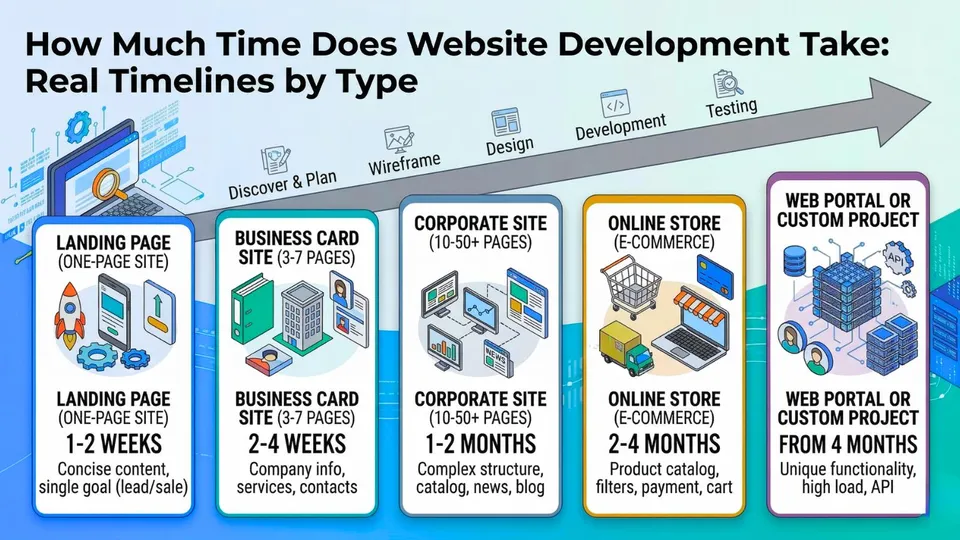
You have decided to commission a site and need a straight answer: how long it will take. Below are calendar-day benchmarks by project type—not vanity “person-hours”—plus why faster is not automatically better, and what usually delays delivery on the client side. Final dates always depend on scope, studio load, and brief quality.
Landing page: 5–10 days—and why not less
Benchmark: 5–10 calendar days for a focused landing when copy and brief are ready.
Why not “48 hours”: even a single page runs through clarification, block structure, design or template adaptation, responsive implementation, forms and analytics, and basic QA. In parallel we need your copy, brand assets, and domain access. When those exist upfront, the lower bound is realistic; when they do not, the timeline stretches—not because builders are slow, but because they wait on inputs.
Ultra-tight schedules without content almost always trade quality: rigid templates, weak mobile UX, or deferred testing.
Corporate website: 14–25 days—what the time covers
Benchmark: 14–25 days for a mid-complexity multi-page site (company, services, cases, contacts, policies as needed).
Where the time goes:
- Structure and prototype—navigation and key templates agreed.
- Design—home, inner templates, responsive treatment.
- Build and content integration—often iterative as copy lands.
- Forms, analytics, SEO basics—metadata, headings, performance.
- Acceptance and revisions—typically 1–3 rounds per contract.
Many pages, multiple languages, custom filters, or CRM hooks push you toward the upper range or a post-MVP phase.
E-commerce: from one month—what pulls the schedule
Benchmark: from ~30 calendar days for a standard catalog, cart, payments, and shipping on a proven stack; complex builds often need two months or more.
Common drag factors:
- Catalog—SKU variants, stock, ERP/Excel imports.
- Payments and shipping—gateways, carriers, test transactions.
- Legal pages and privacy compliance.
- Handover training for your operations team.
More custom logic (subscriptions, B2B pricing, advanced promos) needs a detailed scope—generic timelines stop being meaningful.
What slows delivery (and it is often client-side)
Across project types, delays usually trace to:
- Late or partial copy—design and build wait or rework.
- Multi-stakeholder reviews—“one more colleague” without a deadline.
- Mid-project scope changes—new pages, catalog structure shifts, extra languages.
- Access gaps—domain, hosting, payment provider accounts, third-party APIs.
- No single decision owner—consensus drifts.
Practical planning: add a 15–25% buffer for approvals and content if your org is not same-day responsive.
For budget benchmarks on the same project types, see our article on website costs in Ukraine; align scope before kickoff via the services section.
Timeline table by project type
| Project type | Typical range | Main drivers |
|---|---|---|
| Landing page | 5–10 days | Copy and media readiness, revision rounds, integrations |
| Corporate website | 14–25 days | Page count, languages, bespoke design vs template |
| E-commerce | from ~30 days | Catalog, payments/shipping, imports, custom rules |
| Store + heavy integrations | 60+ days | ERP, stock sync, B2B portals, APIs |
These are market benchmarks, not guarantees: the same “corporate” build can finish in ~12 days with a tight brief or stretch past 35 when scope stays fuzzy.
Conclusion
How long website development takes depends on product type, technical depth, and how decisively your side supplies content and approvals. A realistic schedule with contract milestones beats chasing arbitrary deadlines at the expense of quality.
Want a timeline estimate for your scope? Contact Veb-Dev—we will map phases and a sensible next step.
Tags
- how long website development takes
- landing page development timeline
- corporate website how long
- ecommerce development timeline
- web project schedule
- website launch planning