
Landing Page vs Corporate Site: How to Choose for Your Business
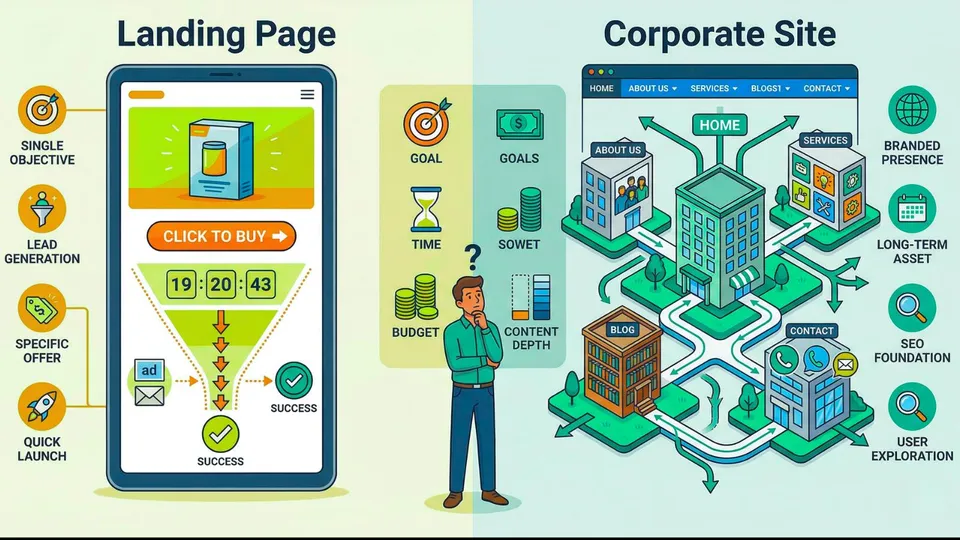
Almost every business owner asks whether to start with a landing page or a full corporate website when going online. The answer depends on the job to be done: one clear conversion versus trust, navigation, and search growth. Below is a comparison without a simplistic “always pick X,” plus practical criteria you can apply to your stage and budget.
What “landing” and “corporate site” usually mean
A landing page in marketing is typically a single page (or a short funnel with a few steps) built around one goal: a lead, booking, purchase, or signup. Traffic is often paid (search or social ads) or tied to a specific campaign, with few distractions.
A corporate website is multi-page: about the company, services or products, case studies, contacts, sometimes a blog, careers, legal pages. It answers “who you are,” “what you do,” and “how to reach you,” and supports SEO and return visits. It does not have to be a huge portal—often 5–15 focused pages are enough.
In the market, terms are fuzzy: some sell a “landing” with five subpages; others sell a “corporate” template that is one long scroll. What matters is structure, metrics, and traffic sources, not the label on the proposal.
Quick comparison
| Criterion | Landing page | Corporate site |
|---|---|---|
| Primary goal | One action (lead, booking, payment) | Brand presence, trust, broader query coverage |
| Typical traffic | Ads, email, narrow campaigns | Search, direct, referrals, ads to different URLs |
| SEO | Limited to one URL; often complements a main site | Better for semantic coverage, local and informational queries |
| Timeline and budget (indicative) | Usually faster and cheaper for the same depth of “one page” | More pages mean more content and UX work |
| Risk | Without traffic, an empty asset; a weak page burns ad spend | Paying for sections you will not maintain or fill |
Pricing and timelines depend heavily on scope and vendor; for formats, deliverables, and examples see the services section on the Veb-Dev website.
When a landing page is the right first step
- One promotional offer with a tight deadline or a narrow audience.
- Hypothesis testing before scaling: does the offer and creative convert at all?
- A focused ad funnel where you already know keywords and a single primary CTA.
- A tight budget and you need speed; a fuller company story can live on socials until a larger site is ready.
Note: a landing page does not replace legally required notices (privacy policy, terms) when you collect personal data—those are often linked in the footer or hosted as separate documents (easier to organize on a multi-page site).
When a corporate site is worth the investment
- B2B, complex services, long sales cycles—buyers compare vendors and look for cases, team, and process.
- Organic traffic across many intents (services in multiple locations, categories, content).
- Multiple product lines that become confusing on a single page.
- Reputation and compliance—partners expect a real “About,” credentials, and legal clarity.
If one long page forces you to dump everything into a single column, comprehension drops and bounce rates rise—that is a signal to split content across pages.
Common mistakes when choosing
- “We will launch twenty pages first and find traffic later”—pages without traffic and updates underperform; sometimes landing + ads ships faster while you plan the bigger site.
- No analytics or event tracking on a landing page—you cannot optimize what you do not measure (form events, goals, UTM on ads).
- A corporate site that clones a competitor’s structure—without a distinct value proposition, neither SEO nor conversion benefits.
- One page forever when you already have five-plus services or regions—users and search engines struggle to see relevance.
What to put in the brief or contract
Regardless of format, it helps to agree in writing on:
- The target action and screen count for a landing, or a sitemap for a corporate build.
- Responsive behavior, baseline performance expectations, languages, and who supplies copy.
- Integrations: CRM, email, messengers, analytics.
- Hosting, domain, and access ownership after handover.
- Warranty, revisions, and how many design or dev rounds are included.
That reduces “we thought the site included X” disputes after launch.
Combined approach: corporate site + landings
A mature pattern is a main site for brand and SEO plus dedicated landing pages for campaigns, webinars, or seasonal offers. You keep main navigation clean while ads stay hyper-focused. Use one analytics setup and consistent lead forms so sales does not chase duplicates.
Conclusion
Landing pages and corporate sites solve different problems: the first maximizes one conversion in a traffic stream; the second builds trust and search presence. The right choice depends on your growth stage, lead sources, and offer complexity—there is no universal answer without context.
If you want help picking a format for your niche and budget, browse services on the Veb-Dev site and use the contact form—we will outline structure and a sensible next step without fluff.
Tags
- landing page vs corporate website
- business website type
- web development
- corporate website
- lead generation
- SEO and site structure